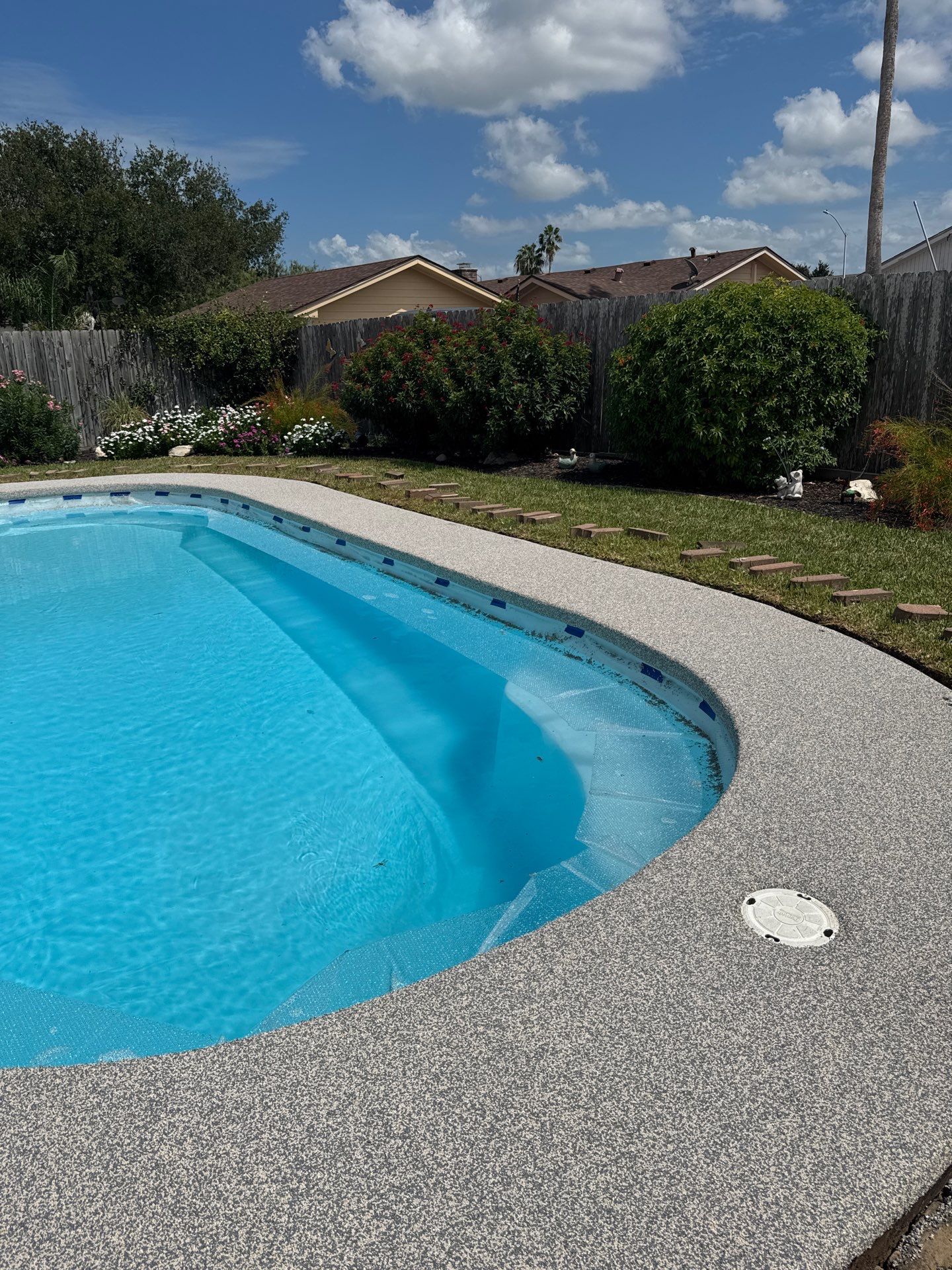
Rubber pool deck vs epoxy Memphis TN homeowners compare is not just a color decision. Both products can change the look of worn concrete, but a pool deck has different demands than an indoor floor. It sees direct sun, splash-out, sunscreen, bare feet, furniture movement, and changing conditions around the water.
That is why the right question is not simply which finish looks best on day one. It is which surface fits a wet, exposed pool environment after a full Greater Memphis summer. For a suitable existing slab, the material choice affects comfort, traction, crack coverage, and how much work the deck needs over time.
Fox uses a hand-troweled EPDM rubber and poly resin system for outdoor pool decks. Epoxy can be a familiar name, but it is a hard coating with a different best-use case.
Why Homeowners Compare Rubber Pool Deck vs Epoxy Memphis TN
Most comparisons start when old pool concrete becomes hard to enjoy. The deck may be stained, rough, hot under bare feet, or smooth enough in high-traffic areas that wet footing feels less secure. Homeowners want an upgrade without defaulting to demolition when the slab still has a useful life.
The existing concrete is still the first decision point. A deck with serious movement, deep structural cracking, or drainage failure may need repair or replacement before any surface is considered. But when the slab is stable and the wear is largely at the surface, several options are worth comparing.
| Factor | Hand-Troweled Rubber Surface | Epoxy-Style Coating |
|---|---|---|
| Best setting | Outdoor pool decks and other suitable exterior concrete | More protected concrete environments |
| Underfoot feel | More forgiving and cooler than concrete in the same sun | Hard, rigid surface that can become uncomfortable in direct sun |
| Wet-foot traction | Slip-resistant texture is built into the finish | Depends on the coating and added texture; smooth wear can be a concern |
| Sun and weather | EPDM rubber is suited to outdoor exposure | Outdoor UV and moisture can be demanding for a hard film |
| Cosmetic crack coverage | Can cover many surface cracks on a stable slab | Rigid finishes can show movement from the concrete below |
| Project scope | Existing suitable concrete can remain in place | Also needs a suitable slab and thorough preparation |
The comparison is not a claim that epoxy has no place. It can work well in the right protected setting. Around a pool, however, heat, water, UV exposure, and barefoot traffic change the standard a surface has to meet.
The Difference Is How the Materials Behave
Epoxy cures as a hard finish. That hard shell can make sense where the concrete is shaded, dry, and not regularly exposed to pool water. A pool deck asks for something else: a surface that can handle regular moisture and outdoor sun while remaining practical around bare feet.
Fox's system is an EPDM rubber surface bound with poly resin. After the concrete is prepared, the material is hand-troweled and heat-rolled for a continuous texture. That mechanism directly supports the benefits homeowners tend to care about:
- Heat comfort: The finished surface runs cooler than bare concrete in the same sun, though it still warms in direct sunlight.
- Wet-foot texture: Slip-resistant texture is part of the walking surface instead of being a separate afterthought.
- Surface renewal: Many cosmetic cracks, stains, and worn spots can be covered when the base concrete is stable.
- Less disruption: A suitable slab can remain in place instead of becoming a demolition and replacement project.
- Outdoor purpose: The system is selected for exposed outdoor concrete, not borrowed from an indoor-floor use case.
Concrete condition remains the boundary. Neither rubber nor epoxy should be used to hide active movement or a structural failure. A professional assessment should explain when a deck is a responsible resurfacing candidate and when it is not.
See which surface fits your existing pool deck - get a free, no-pressure quote.
What to Consider Before Choosing Either Surface
Start by identifying the problem you want to solve. If the main issue is a worn indoor-style floor, epoxy may belong in the comparison. If the deck is outside the pool, the everyday experience usually centers on heat, water, and traction.
Look closely at the routes people use most. Pool entries, steps, gate paths, seating areas, and the walk back to the house receive the most wet-foot traffic. Note where water stays, where existing texture has worn down, and whether cracks are stable. Those details are more useful than choosing a material from a small sample alone.
The same is true across Greater Memphis, from Bartlett and Germantown to Collierville and Southaven. Regional climate makes the comparison relevant, but each deck's layout, drainage, slab condition, and access determine the responsible recommendation.
For another material comparison, read Kool Deck Alternative Memphis TN for Cooler Pool Decks.
If traction is the leading concern, our Slip-Resistant Pool Deck Memphis TN: Safer Summer Days explains what to look for around the water.
Why Fox Uses Rubber for Suitable Pool Decks
Fox focuses on outdoor concrete resurfacing with pool decks as the primary offer. We inspect the concrete first, then recommend the EPDM rubber and poly resin system only when the slab is a fit. The material is hand-troweled and heat-rolled to create a continuous, textured pool-deck surface.
That process can deliver a useful outcome without a generic promise. A qualifying project can cover surface wear, improve the feel underfoot, and retain sound concrete. Many suitable residential decks can be completed in a day, depending on size, repairs, access, and weather.
Fox is licensed and insured. Qualifying homeowner projects include a 12-year written warranty, and the surface is built to last 15+ years in normal residential use. We do not claim a rubber deck stays cold in direct sun, and we do not treat a failing slab as a surface-only project. Clear expectations are part of a good pool-deck recommendation.
For the broader process, visit our Memphis pool deck resurfacing hub. You can also browse color options after the concrete condition and surface direction are understood.
Quick FAQ
Is epoxy always wrong for exterior concrete?
Not necessarily. The right system depends on the setting. For an exposed pool deck, the combination of sun, water, and wet-foot traffic makes an outdoor rubber surface a stronger fit for many suitable slabs.
Is rubber resurfacing cooler than epoxy?
Rubber resurfacing runs cooler than bare concrete in the same sun and is designed for more comfortable barefoot use. It still warms in direct sunlight, so it should not be described as cold.
Can rubber resurfacing cover pool-deck cracks?
It can cover many cosmetic cracks when the concrete is stable. Cracks tied to active movement, settlement, or structural failure need a different assessment first.
How long does a rubber pool-deck surface last?
Service life depends on the concrete, exposure, installation, and care. Qualifying Fox homeowner projects are backed by a 12-year written warranty.
Free Estimate
Ready to resurface your pool deck?
See what a cooler-underfoot, slip-resistant pool deck could look like at your home.
Our 60/60/60 Sale is on: a $60 gift card, 60% off installation, and your install guaranteed within 60 days.
Get Your Free Pool Deck Quote →Free, no-pressure, and we'll call you within 5 minutes.