If you're comparing a rubber pool deck vs epoxy, you're already asking the right question. Both can cover old concrete. Both can change the look of the space fast. But around an Arkansas pool, they do not behave the same once the sun, splash water, and freeze-thaw cycles start working on them.
That matters because pool decks live in harsher conditions than most outdoor concrete. Bare feet, wet surfaces, chlorine, long summer sun, and winter temperature swings all hit the same slab. A surface that works in a garage can be the wrong answer outside.
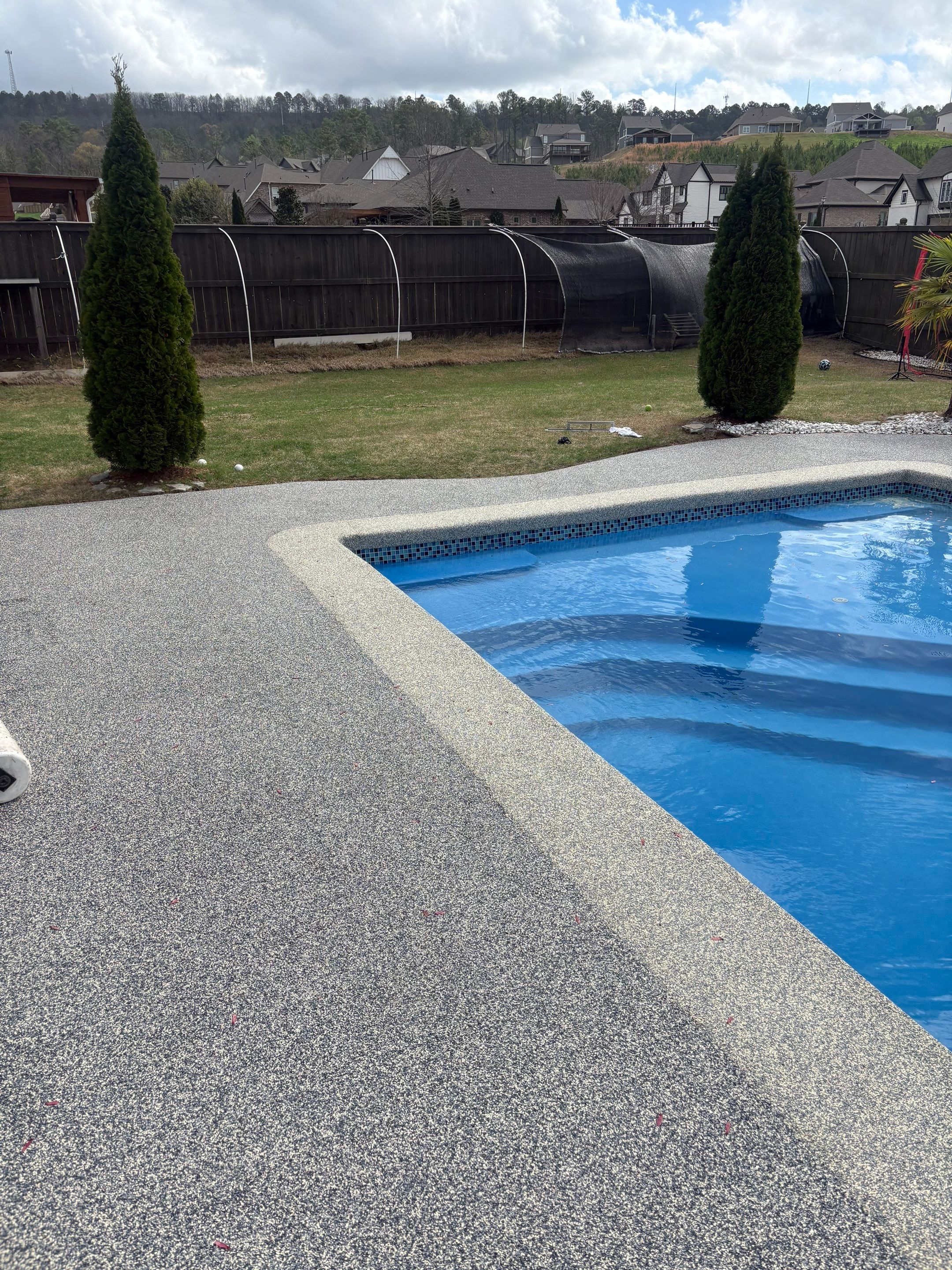
The short version: epoxy is a hard, shiny coating that works best in protected spaces. Fox's rubber system is a hand-troweled EPDM rubber surface built to flex, stay grippy, and run cooler than concrete around the pool.
Why Homeowners Compare Rubber Pool Deck vs Epoxy
The comparison usually starts with a simple goal: cover up old pool concrete without tearing the whole deck out.
Most homeowners are looking at the same list of problems:
- The deck is cracked, stained, or chipped
- Bare concrete gets too hot in the sun
- The surface feels slick when kids are running through water
- They want a better look without a full demolition project
On paper, epoxy can sound tempting because people know the name and it often shows up with a lower upfront number. The problem is that outdoor pool decks ask for a different kind of performance than an indoor slab. Around water and sun, the surface has to do more than just look clean on install day.
Rubber Pool Deck vs Epoxy: What Changes Outside
Here is the honest side-by-side.
| Factor | Rubber Pool Deck (Fox) | Epoxy |
|---|---|---|
| Best use | Outdoor pool decks, patios, walkways | Garages, shops, covered areas |
| Surface feel | Softer, more forgiving under bare feet | Hard, rigid surface |
| Heat in sun | Cooler than concrete | Can get hot in direct sun |
| Grip when wet | Slip-resistant by texture | Can get slick, especially with wear |
| UV performance | UV-stable | Can chalk, amber, or fade outside |
| Crack handling | Bridges and covers surface cracks | Tends to telegraph slab movement |
| Install approach | Hand-troweled and heat-rolled | Rolled or squeegeed hard coating |
| Demolition needed | No, goes over existing concrete | No, if slab is suitable |
The biggest difference is not color or style. It is how the material behaves.
Epoxy cures into a hard shell. That is fine on an interior garage floor where the slab stays relatively dry, shaded, and stable. On a pool deck, that same hardness becomes the weakness. The slab underneath expands and contracts. Water hits it daily. UV pounds it for months at a time. Over time, epoxy can lose its clean look, turn slick, or show the same cracks and movement you were trying to hide.
Rubber works differently. Fox installs a hand-troweled layer of EPDM rubber granules bound in a poly resin directly over the existing deck. EPDM is engineered to live outdoors. It flexes with temperature swings instead of fighting them, and the finished texture gives you real grip around the water's edge.
If your main question is, "Which one is better for a real outdoor pool deck?" the answer is usually rubber.
Want to see the difference on your own deck? Get a free, no-pressure quote.
Where Epoxy Falls Short Around a Pool
Epoxy is not a scam. It is just often used outside of its best lane.
Here is where it typically loses ground on a pool deck:
- Sun exposure: many epoxy systems are not truly happy in full outdoor UV. Over time they can yellow, chalk, or lose their fresh finish.
- Wet-foot traffic: a harder, smoother coating is more likely to feel slick when splashed all day.
- Heat: epoxy does not solve the hot-deck problem the way homeowners expect. Around a pool, comfort under bare feet matters.
- Slab movement: if the concrete underneath has hairline cracking or seasonal movement, a rigid coating tends to show it again.
That is why so many epoxy jobs look strongest in garages and weakest on exterior concrete. The environment is doing the sorting.
For a deeper look at outdoor pool-deck options, Fox also breaks down pool deck resurfacing costs in Arkansas and another common Kool Deck alternative in Little Rock.
Why Fox's Rubber System Wins for Pool Decks
Fox built the system around the actual job the surface has to do outside.
We go over your existing concrete, so there is no tear-out if the slab is structurally sound. Then we install a hand-troweled EPDM rubber finish and heat-roll it to lock in the texture and bond. That spec turns into real homeowner benefits:
- Cooler than concrete in the same sun, which matters in bare feet
- Slip-resistant texture around splash zones and steps
- Covers cracks and worn spots without replacing the whole deck
- Softer underfoot than a hard coating
- Built for outdoor UV and weather, not borrowed from an indoor-floor system
- Written 12-year warranty on the finished work
It also gives you a cleaner visual reset. You keep the slab, but the space stops looking patched together and tired. You can browse finish options on our colors page and see the surfaces we coat in our services section.
Just as important, the install is honest. We do not pretend any outdoor surface stays cool at all times in July. The right promise is that it runs cooler than concrete and feels better to live on. That is the standard we write to.
Fox is Arkansas-licensed and insured, serving Arkansas and Greater Memphis. Pool decks are one of the clearest places where the right surface choice changes how the space feels every day.
Quick FAQ
Is epoxy bad for every outdoor project?
Not every project. But for a pool deck, it is usually the wrong fit compared with a rubber surface because heat, water, UV, and slip resistance matter more there than on most exterior slabs.
Does a rubber pool deck feel soft?
It feels more forgiving under bare feet than hard concrete or epoxy. It is still a durable outdoor surface, but it does not have the same hard-shell feel.
Can you install rubber over your old pool deck?
Usually, yes. If the concrete is structurally sound, Fox can resurface right over it without demolition. If there is active structural movement, we will tell you that during the inspection.
Is rubber harder to maintain than epoxy?
No. Routine cleaning is simple. You are not dealing with a painted-looking film that needs to stay cosmetically perfect. The texture and performance are built into the surface itself.
For another Central Arkansas perspective, compare Slip-Resistant Pool Deck Surface for Arkansas Homes with Stamped Concrete vs Rubber Pool Deck: Better Outside before choosing the surface approach that fits your property.
Free Estimate
Ready to resurface your pool deck?
See what a cooler-underfoot, slip-resistant pool deck could look like at your home.
Get 15% off or 12 months no interest*. Fall offer ends 12/19/26.
Get Your Free Pool Deck Quote →Free, no-pressure, and we'll call you within 5 minutes.