You've got a crack — or five — running across your patio, and every time you walk out back you notice it a little more. Maybe it started as a thin line a couple of summers ago, and now it's wide enough to catch a chair leg.
Here's the good news: figuring out how to cover a cracked patio doesn't mean mixing concrete or renting a jackhammer. In most cases you don't fix a patio crack-by-crack, and you definitely don't have to tear the whole thing out. You cover it — all at once — with a new surface that goes right over the top.
Let's walk through how that works, the way we'd explain it standing in your backyard.
First, Figure Out What Kind of Crack You Have
Before you cover anything, it helps to know what you're dealing with. Not all cracks are equal, and the difference decides whether covering is the right move.
- Surface cracks — thin, spidery, or hairline cracks in the top of the slab. These are the most common, especially in Arkansas, where the freeze-thaw swings and summer heat work on the surface every year. These are exactly what a resurfacing system is built to cover.
- Settling cracks — slightly wider cracks where one side has dropped a little. Often still coverable, depending on how active they are.
- Structural cracks — wide, growing cracks where the slab is actively heaving or sinking, usually from soil movement underneath. This is the one case where you don't just cover — the slab needs a look first.
The honest rule: if your patio is cracked but still solid underfoot — not see-sawing, not crumbling — you're almost certainly a candidate to cover it. If a slab has real movement, we'll tell you straight when we come out.
Why Patching or Painting Usually Lets You Down
Most folks try one of two quick fixes first, and both tend to disappoint.
Filling each crack with caulk or concrete patch is a temporary bandage. The patch is a different material than the slab, so it shrinks, discolors, and the crack telegraphs right back through within a season or two. You can see every repair — and you're back at it next year.
Painting or rolling on a concrete paint hides the crack for a little while, but paint isn't built for an Arkansas patio that bakes all summer. It peels, bubbles, and flakes — and a painted-over crack is still a crack underneath.
These fail for the same reason: they treat the crack instead of replacing the surface. To actually cover a cracked patio for good, you need a new wear layer that bridges the cracks and flexes instead of fighting them.
How We Cover a Cracked Patio for Good
Here's the method that actually lasts, and it's simpler on your end than you'd think.
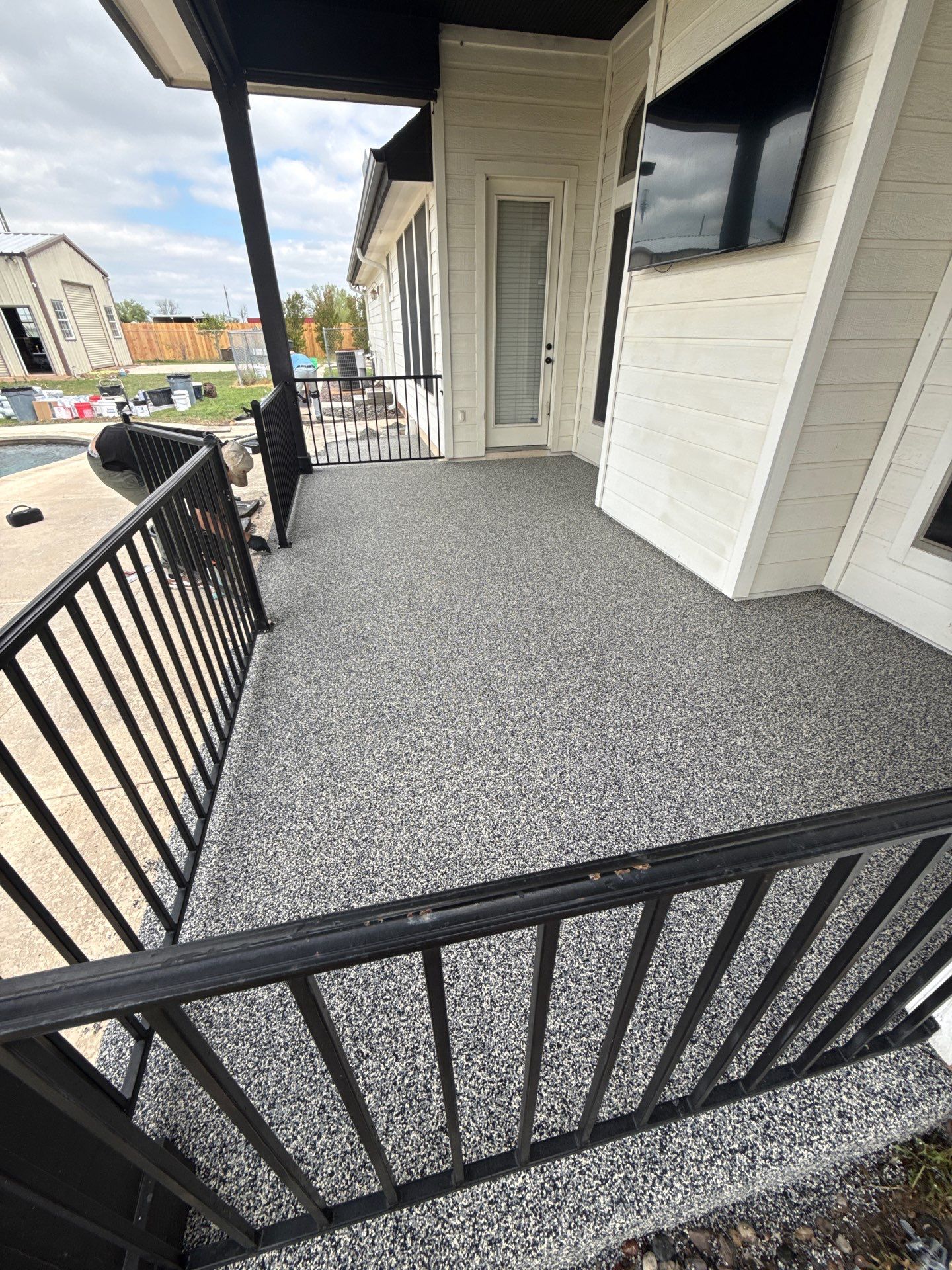
We resurface the whole patio with a hand-troweled rubber coating — EPDM rubber granules blended with a poly resin — applied right over your existing concrete. Because it's rubber-based, it moves with your slab through the temperature swings instead of cracking the way a rigid material would. The thin surface cracks underneath get bridged and covered.
The day looks like this:
- We clean and prep the existing patio so the new surface has something to grip.
- We hand-trowel the rubber coating over the top to an even thickness.
- We heat-roll it to lock in the texture and set the bond.
- You've got a finished, crack-free patio — usually in a single day, and you can walk on it the same evening.
No demolition. No dumpster in the driveway. No week of your backyard being a construction zone.
Want to see what your patio could look like? Get a free, no-pressure quote.
What You're Left With
Once it's covered, the cracks aren't the only thing that changes. The new surface is:
- Slip-resistant, even when it's wet from a summer storm — the texture grips underfoot.
- Cooler than bare concrete in the same sun, so it's friendlier on bare feet in July (cooler, not cool at all times — it'll still warm up in direct sun).
- Easy to clean — just hose it off. No resealing, no repainting.
- Yours to design — it comes in a range of signature Fox color blends, so you can finally pick a look that matches your house instead of plain gray. Take a look at our color options.
And it's built to hold up. Every job is backed by a written 12-year warranty, and we're Arkansas-licensed and insured, serving Arkansas and Greater Memphis. You can see all the surfaces we coat on our services page.
Covering a Cracked Patio: Quick Questions
Will the cracks come back through?
For normal surface cracks, no — the rubber surface bridges them and flexes with the slab, so they don't telegraph back through the way a patch or paint does.
Do you have to replace any of the concrete?
In most cases, no. As long as your slab is structurally sound, we cover it as-is. If part of it has real movement, we'll flag that when we look.
How long does it take?
Most patios are finished in a single day, and you can walk on the new surface that same evening.
How do you take care of it afterward?
Just hose it off when it needs it. There's no sealing or repainting — the surface is built to handle Arkansas weather and everyday use.
For another Central Arkansas perspective, compare Kool Deck Alternative for Little Rock Pool Decks with Patio Resurfacing Benton AR: Cover Cracks Without Demo before choosing the surface approach that fits your property.
Free Estimate
Have an outdoor concrete project?
Pool decks are our specialty. We also consider patio projects when the surface is a good fit.
Our 60/60/60 Sale is on: a $60 gift card, 60% off installation, and your install guaranteed within 60 days.
Request an Outdoor Concrete Quote →Free, no-pressure, and we'll call you within 5 minutes.